 Recondition Power Tool Batteries DIY
How to revive a NiCad power tool battery
You revive a NiCad power tool battery by confirming the shell says NiCad, finding the cell that sits near a dead reading, and using a brief high-current hit to clear crystal whiskers — the full fork is on how to recondition dead power tool batteries.
Whiskers are the nickel fault, not a sleeping board
Old NiCad tool packs fail in a way lithium packs do not. Inside a nickel cell, conductive crystals can grow until they bridge the plates. People call them whiskers. A bridged cell sits near a dead reading while the cells beside it still show a number on a meter. The tool dies, and a charger may refuse the pack or finish in a way that never brings that one cell back.
Zapping is the name for a brief high-current hit meant to burn that bridge clear. The new fact here is the target: you are trying to clear a crystal short inside a nickel cell, then you meter again. You are not waking a lithium protection board, and you are not balancing an 18V string by force. If the shell does not say NiCad or NiCd, this page is the wrong instruction.
Read the cell before you hit it
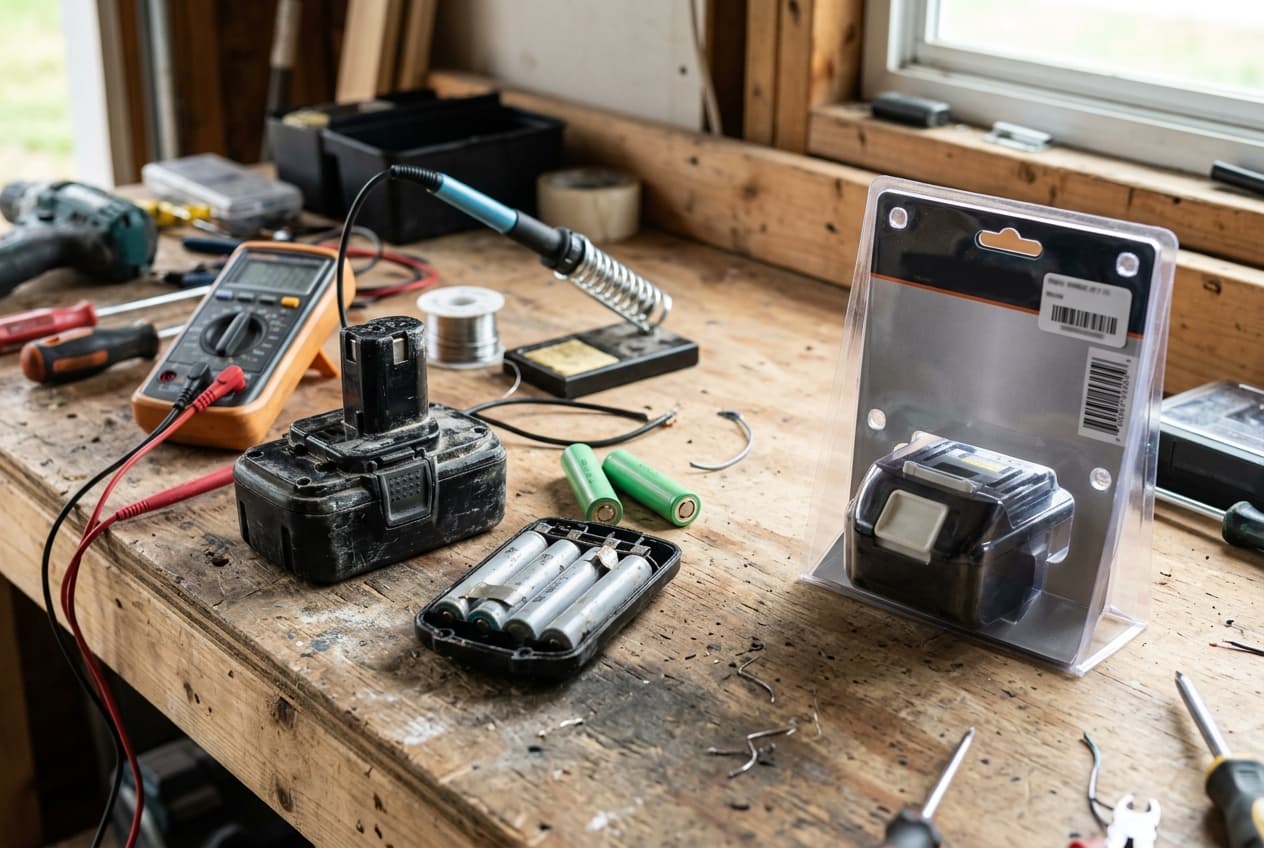
Open the pack only if the case is intact, cool, and dry. A split or leaking nickel cell is retired, not zapped. Write down every cell with a meter first. The method for that reading is on how to test power tool battery cells. You want the cell that sits apart, usually the one closest to a dead reading, and you want the others noted so you can see whether the hit changed anything.
A pack where every cell sits together, and the tool still sees nothing, is not a whisker story. On a lithium label that pattern points at the board. On a nickel label it may be a worn string that no longer has a single short to clear. Zapping every cell because the drill is quiet is how you heat a pack that did not have a bridge.
The shape of the hit, without a made-up timer
The listing this site points at does not print a current, a voltage, or a count of seconds for the hit. This page will not invent those numbers. What can be said in plain language is the shape of the step.
- Confirm the label says NiCad or NiCd.
- Meter the cells and mark the one that sits near a dead reading.
- Apply a brief high-current contact to that cell only, then take the source away.
- Let the cell sit a moment. If it is hot, you are finished with it.
- Meter that cell again, and meter its neighbors.
- If the dead cell now sits with the others, charge the pack on its own charger and try the tool.
- If the cell stays at a dead reading, or the case warms, retire the cell. Do not stack hits.
The source of that current, in a home shop, is whatever the full method you trust specifies. Last Battery's listing says the work uses materials you already have at home and takes about three minutes per battery, and it names power tool batteries among other cells. This site did not perform the hit or time it. Treat any specific rig you see in that video as the video's instruction, not as a number added here.
After the reading moves, or does not
A cell that climbs back toward its neighbors is a candidate for a normal charge. Watch the pack on the charger. Nickel packs can get warm in ordinary use, but a cell that is too hot to hold, or a case that vents, is the end of the experiment. A cell that stays dead after one brief hit is telling you the bridge was not the whole story, or the plates are already worn through. Another hit is not a plan.
Do not celebrate a single meter bump and put the pack straight into a ceiling install. Run the tool on the bench with nothing under it. If runtime is a small fraction of what that pack used to give, the string is tired even if one whisker cleared. That is a replacement decision, not a second zap.
Lithium cells do not get this treatment. A high-current hit on a lithium cell is outside this page on purpose. If you are holding a lithium shell, go back to the reconditioning guide and take the jump fork instead.
When the nickel pack is only one part of a mixed drawer, the order of checks before you buy anything is on the guide: how to recondition dead power tool batteries.
Last Battery
Last Battery is the listing to use when the shell says NiCad and you want the home method the page says covers power tool batteries in about three minutes with materials you already have.
This site earns a commission through ClickBank on a qualifying purchase.
Questions
What are you clearing when you zap a NiCad tool battery?
Crystal whiskers that can grow inside an old nickel cell and short it. The hit is a brief high current meant to clear that bridge so the cell can show a reading again.
Can you zap a lithium power tool battery the same way?
No. A lithium pack that seems dead may have a board holding the output open. A whisker hit is the wrong tool for that pack.
How do you know which cell to hit?
Meter every cell first. The suspect is the one that sits near a dead reading while the others still show a number. If they all match, a zap is not the next step.
What if the cell stays dead after one hit?
Retire it. Heat or a second hit is not a plan this page supports. A cell that will not move is a replacement problem.