 Recondition Power Tool Batteries DIY
Reconditioning vs replacing power tool batteries
Reconditioning beats replacing when the pack is cool and intact and the meter shows a fault you can match — a sleeping board, NiCad whiskers, or one low cell — while replacing wins when the case is swollen, hot, leaking, or the outlier cell will not move. The steps live on how to recondition dead power tool batteries.
The difference you can actually use
Reconditioning and replacing are not two moods. They are two outcomes for the same quiet drill. Reconditioning, as this site uses the word, means you name the chemistry, meter the cells, and try the matching step before you buy a shell. Replacing means you buy a new pack and the old one stays on the shelf, fixed or not.
The real difference is what you spend the first hour on. The Last Battery listing says its method takes about three minutes per battery and uses materials you already have at home, and it names power tool batteries along with car batteries and old AA and D cells. A replacement pack does none of that. It gives you a new string for one tool and leaves the old pack unexamined. That is a real fork, not a slogan. This site did not shop a replacement or time the three minutes. The time and the materials are the listing's lines.
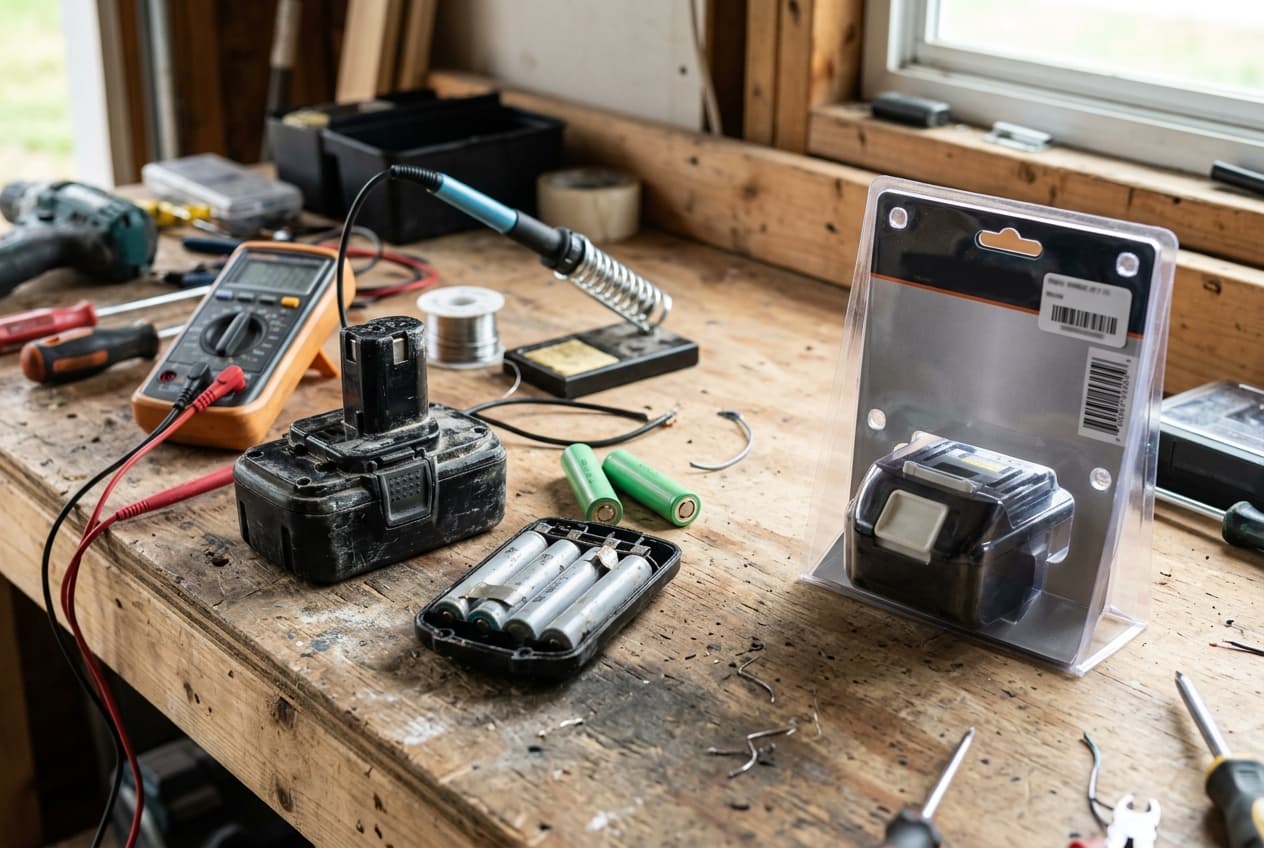
The constraint, the size, and the failure you fear
The constraint is a dead cordless pack you would rather not throw out. The size that matters on the shell is the voltage name, 18V or 20V, because that name is a series string, plus the chemistry line that tells you whether you are holding lithium or NiCad. The failure you fear is paying for a new pack when a sleeping board or one low cell was the whole story, or the opposite fear: opening a pack that is already unsafe and making a bad day worse.
Read that table as a choice, not as a score. If your pack is swollen or hot, the right column is the stop, and the button on this page is not an invitation to keep going. If your pack is intact and the meter row shows a matched fault, the left column is the one this page prefers, because you learn whether the pack had a small fault before you pay for a new one.
Which side this page prefers
Prefer reconditioning when all of these are true: the case is cool and intact, you can read the chemistry, and the meter row matches a sleeping lithium board, a single shorted NiCad cell, or one low cell in an 18V or 20V string. In that situation the listing's method is the option this page names, because it is aimed at power tool batteries and it claims household materials and a short time per battery. The walk-through that keeps those faults from getting mixed is the reconditioning guide linked in the first sentence.
Prefer replacing when any of these are true: the case is swollen, split, hissing, or hot; a cell leaks; you cannot tell positive from negative through corrosion; or you already metered, tried the matching step, and the outlier cell stayed apart. A new pack is then the cleaner spend. Reconditioning a ruined cell does not become wiser because a video exists.
There is a third situation people skip. The tool may be the problem, or the charger may be. If a known-good pack also fails in that tool, you are not in a battery decision at all. If the suspect pack runs in a second tool, you are back to the cell row. Test the cells before you let the chuck convince you the whole pack is trash.
Last Battery
Last Battery is the pick on the reconditioning side of this page because the listing describes about three minutes per battery with materials you already have, and it names power tool batteries.
This site earns a commission through ClickBank on a qualifying purchase.
Safety is the column people skip
Opening a shell is the risk on the reconditioning side. You accept it only after the outside of the pack has passed the look: no swell, no heat, no leak. Probes stay on one cell. Donor packs for a lithium wake-up wear the same voltage name and come off again immediately. A NiCad hit stays on a nickel cell. None of those sentences are a regulation quoted from an agency. They are the stops this site will say out loud so the comparison is not only about money and time.
Replacement has its own miss. A new pack that does not match the tool's voltage name is not a repair. The 18V shell and the 20V shell can look like cousins on a bench. The printed name is what you match, not the color of the handle. Buying the wrong name wastes the purchase the same way opening the wrong chemistry wastes the afternoon.
Two packs on the same bench
Picture a drawer with two quiet packs and one drill that still spins when a third pack is clicked in. The drill is not the mystery. The two quiet packs are. Take them one at a time. Read the chemistry on the first shell. If it says lithium and the case is cool, meter the cells. A row that sits together means the reconditioning side of the table is still open: the board may be asleep, and the listing method is the hour you spend before a new shell. A row with one cell far below the others is still the reconditioning side only while that cell stays cool and starts to move. The moment it will not move, you have crossed to replacement for that pack alone.
The second pack does not inherit the first pack's result. A nickel shell in the same drawer is not "also asleep." It gets its own meter row. If one nickel cell is the dead reading, whiskers are the question, and a lithium jump borrowed from the first pack is the mistake the table is trying to prevent. If that nickel cell is leaking, replacement or retirement is the column, even if the lithium pack beside it was a fair video candidate.
This is the part of the cost that is not a price. The expensive miss is treating the drawer as one decision. Reconditioning the intact pack and retiring the damaged one can both be right on the same Saturday. Buying two new packs because one of them was swollen spends the replacement on a pack that never needed it, and also spends it on a pack that should never have been opened. The listing does not change that split. It only describes a home method for the packs that are still candidates.
What was not tested
No pack was revived for this page. No replacement was priced, because a price would go stale and the listing's button is not a store shelf. The preference stands on the difference above: a described home method for the packs the listing names, versus a new pack that leaves the old one unopened. If the left column fits your pack, the video is Last Battery. If the right column fits, put the button down and buy the matching shell, or retire the damaged one.
The guide that holds the order of work is how to recondition dead power tool batteries. Use it before you treat this comparison as permission to skip the meter.
Questions
When is reconditioning the better choice than a new drill battery?
When the pack is cool and intact and the meter shows a sleeping lithium board, NiCad whiskers, or one low cell in the string. That is the case where a short home method can answer the fault before you buy.
When should you replace the pack instead?
When the case is swollen, hot, split, or leaking, or when the weak cell will not move after the matching step. Also replace, or rather do not work the pack, if you cannot read the terminals safely.
What is the concrete difference between the two paths?
The listing method is described as about three minutes per battery with materials you already have, and it names power tool batteries among other cells. A replacement is a new pack for one tool, and the old pack stays unexamined.
Does this page assume a hands-on test?
No. The three minutes and the materials are lines from the Last Battery listing. This site did not time them or run the video on a pack.