 Recondition Power Tool Batteries DIY
How to jump start a dead lithium power tool battery
You jump start a dead lithium power tool battery only when the label says lithium, the case is intact and cool, and the tool sees nothing because the board may have opened the output while the cells still hold a charge — the full order sits on how to recondition dead power tool batteries.
The tool can be silent while the cells are not
A lithium cordless pack is a string of cells plus a small board. That board can open the output to protect the string. When it does, the tool behaves as if the pack were empty. The charger may blink, refuse the pack, or sit there doing nothing you can trust. None of that, by itself, proves the cells are finished. It proves the output is open.
That is the new fact on this page: the dead reading at the tool can be the board, not the cells. A jump here means a brief connection at the pack output from a known-good pack that wears the same voltage name, long enough for the sleeping board to close, and then you take the donor away. It is not a way to fill a ruined cell, and it is not the whisker hit used on old NiCad packs.
Match the label before any wire touches
Read the shell. You want a lithium line, and you want the voltage name, 18V or 20V or whatever is printed, to match the donor pack you might use. A donor with a different voltage name is not a helper. It is a mismatch. If the shell does not say lithium, leave this page and use the guide that matches the chemistry you actually have.
Then look at the case. Swollen, split, wet, hissing, or hot means you do not jump it. Those signs are the pack telling you the cells are not in a state where a wake-up is the job. Set that pack aside. Do not pair it with a good pack "just to see."
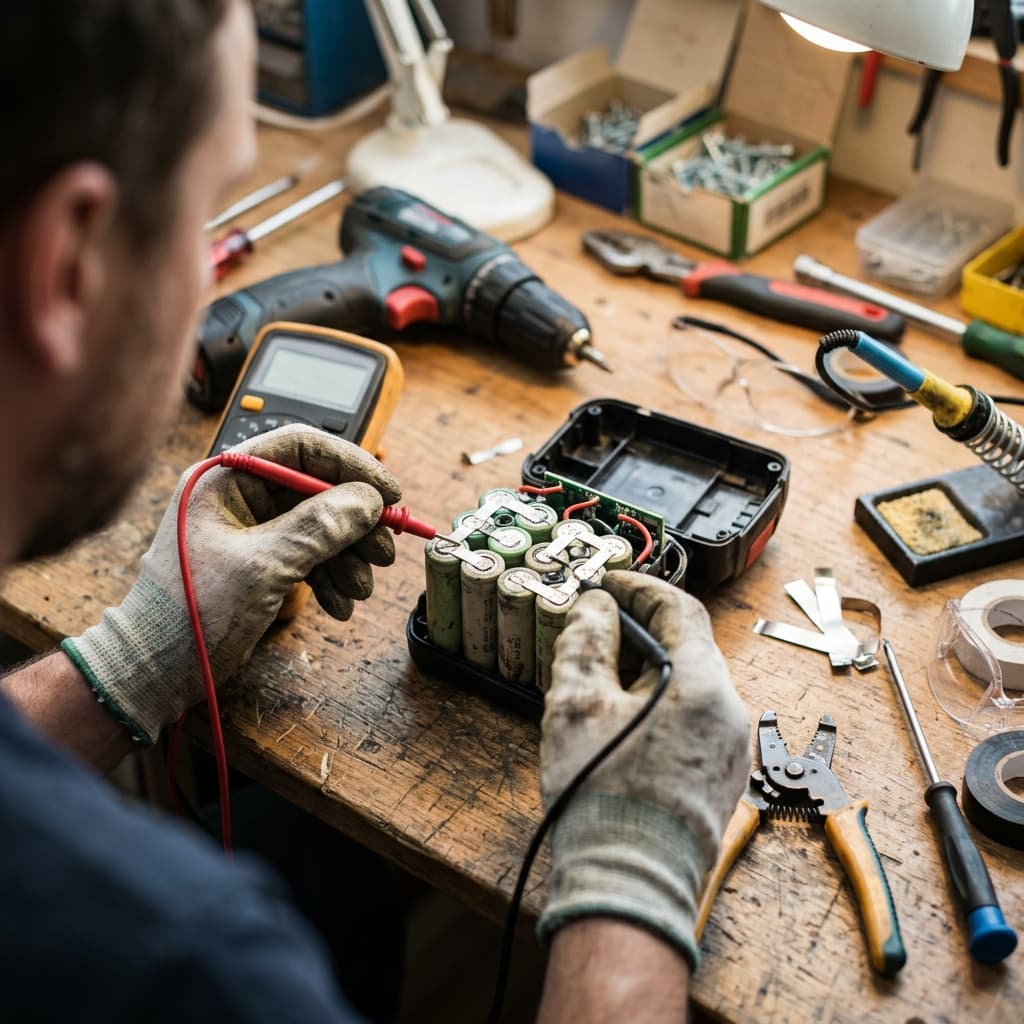
If the case is quiet, the next proof is a meter, not a guess. The cell-by-cell reading is on how to test a power tool battery with a multimeter. You are looking for cells that sit near one another. A string of similar readings plus a tool that still sees nothing is the pattern for a sleeping board. One cell far from the others is a different fault, and a jump of the output will not balance that string.
What the short contact is, in plain steps
- Confirm the label says lithium and note the voltage name.
- Confirm the case is cool, closed, and not swollen.
- Meter the cells if you can do that without forcing a damaged shell.
- Take a known-good pack with the same voltage name.
- Touch donor positive to sleeper positive, and donor negative to sleeper negative, at the output terminals.
- Keep that contact short. You are asking the board to wake, not charging the string through a bypass.
- Separate the packs completely.
- Offer the sleeper to its own charger, then try it in the tool.
Do not leave the two packs tied together on the bench. Do not reverse the terminals. Do not use this contact on a pack that warmed up during the touch. If anything smells sharp or the shell flexes, you stop and you do not try a second hit.
After the board closes
A pack that wakes is not automatically a healthy pack. Put it on its charger and watch the first minutes. A normal charge is quiet. Heat, a ticking case, or a charger that still refuses the pack means you are done experimenting. If the tool runs and then dies far earlier than it used to, the board may have closed while one cell in the string is still low. That is a balance problem, not another jump. Treat a second jump as a repeat of a step that already told you its answer.
This site did not jump a pack and time the contact. The listing that describes a home method of about three minutes per battery, using materials you already have, is Last Battery. The listing names power tool batteries among car batteries and loose AA and D cells. That video is the long form. This page is only the lithium fork: a sleeping board, a matched donor, a short contact, and a stop if the case complains.
If the label is nickel instead, do not import this step. Whiskers and a zap belong on the NiCad page, because the physics inside the cell is different and the risk of using the wrong hit is the whole point of separating the guides.
The reconditioning order, from the label through the meter to the fork you pick, is on how to recondition dead power tool batteries. Use that page when you still are not sure the silence is a sleeping board.
Last Battery
Last Battery is the video to open after the label says lithium and the cells still read near one another, because the listing says the method covers power tool batteries with materials already at home.
This site earns a commission through ClickBank on a qualifying purchase.
Questions
Why would a lithium pack need a jump if the cells still have a charge?
The board inside can open the output. The tool then sees an empty pack even though the cells have not all gone flat. A brief matched contact is meant to let that board close again.
Which pack can you use as the donor?
A known-good pack with the same voltage name printed on the shell. A different voltage name is a mismatch, and a swollen sleeper is not a candidate at all.
Should you leave the two packs connected?
No. The contact is brief. After it, the packs are separated, and the sleeper goes to its own charger or the tool.
What if one cell reads far from the others?
That pattern is not a sleeping board. Jumping the output will not equalize the string. Meter the cells and treat the outlier as its own fault.