 Recondition Power Tool Batteries DIY
Recondition power tool batteries at home
A dead cordless pack is worth a label check and a cell-by-cell meter reading before you buy a replacement, and the full order is on how to recondition dead power tool batteries.
Last Battery
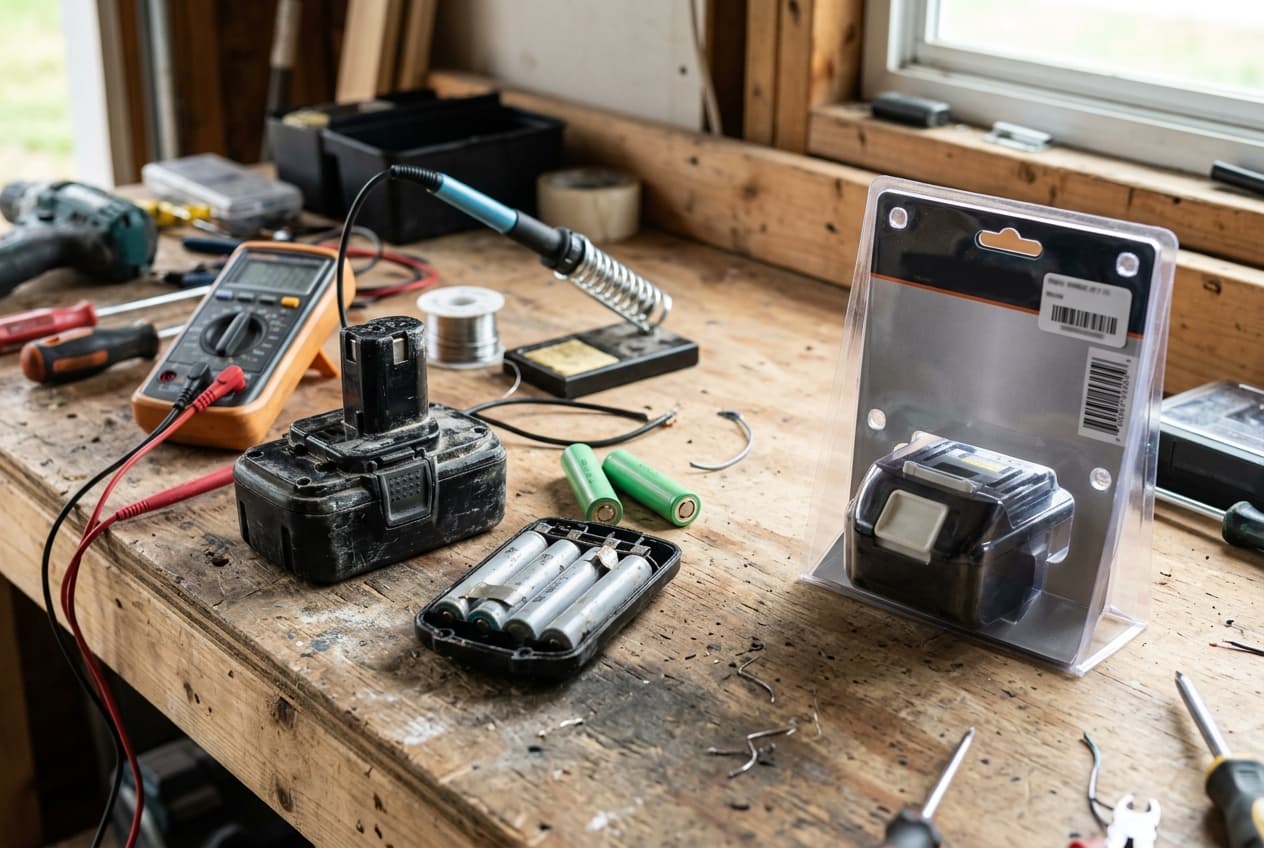
Last Battery is the video listing for a quiet, intact pack: the page is titled Last Battery™, the main photo is the garage scene, and the listing says about three minutes per battery with materials you already have.
This site earns a commission through ClickBank on a qualifying purchase.
The packs on this site are the cordless ones that go quiet in a garage: lithium packs whose board may have opened, older NiCad packs that grow crystal whiskers, and 18V or 20V strings that quit because one cell sits lower than the rest. The work is the same shape every time. Read the shell, look for heat or swell, write down each cell, then pick the matching step. A swollen or hot case is not a project.
Pages for the pack in your hand
- Recondition a dead pack. The order from the label to the fork, and the listing lines you can check.
- Jump a dead lithium pack. A brief matched contact when the tool sees nothing and the cells still agree.
- Revive a NiCad pack. Whiskers inside an old nickel cell, and why that hit stays off lithium.
- Test cells with a meter. One cell at a time, so a weak cell cannot hide behind the outer terminals.
- Recondition or replace. The listing method against a new pack, including the stop signs.
- Balance an 18V or 20V string. The low cell that makes a labeled pack die early.
- 4 ways to recondition a drill battery. Ranked for a pack you have not diagnosed yet.
- 5 checks before you replace. Outside of the shell first, video only after a pass.
- 4 fixes for an 18V pack that will not charge. Start by matching the printed voltage name.
- How a listing is chosen. What has to be visible before a product is repeated here.
- Privacy. What this site collects, and where the button sends you.
If you buy through the Last Battery button, this site earns a commission through ClickBank on a qualifying purchase. The three minutes and the materials are the listing's lines. They were not timed on a pack for these pages.
Use the reconditioning guide again when you are ready to start: how to recondition dead power tool batteries.
Questions
Can you recondition a dead power tool battery at home?
Yes, when the case is cool and intact. Read the chemistry, meter each cell, and match the fault to a sleeping lithium board, NiCad whiskers, or an uneven 18V or 20V string.
What does the Last Battery listing claim?
The listing is titled Last Battery™. It shows a garage photo, says the method takes about three minutes per battery, says you use materials you already have, and names power tool batteries, car batteries, and old AA and D cells.
When should you replace the pack instead?
When the case is swollen, hot, split, or leaking, or when the weak cell will not move after the matching step.
Was the video tested here?
No. The pages repeat the listing title, the photo, and the lines about time, materials, and cell types. A purchase through the button can earn this site a commission through ClickBank.